Car Detailing at Home Starts With the Right Kit
A car in Pakistan collects a fresh coat of fine dust every day, and a quick roadside wash only moves the top layer around. Detailing goes further: it lifts the grit safely, dries the paint without scratching it, brings back the gloss and sorts out the tyres.
Doing car detailing at home takes four machines and roughly half a day. Each one has a single, clear job:
- Rinse. A high-pressure lance lifts grit before anything touches the paint.
- Dry. A hand-held blower chases water off without a towel.
- Polish. A variable-speed buffer restores gloss to dull, swirled panels.
- Finish. A small compressor tops up the tyres and clears tight gaps.
This is the deep-clean session, done every few months. The habits that keep a car healthy in between — paint protection, the engine bay, the monsoon underbody — are covered in the complete heat, dust and monsoon routine.
Pro tip: every machine here runs on mains power. Check the load-shedding schedule first and start right after the electricity returns, because a buffer that cuts out mid-panel leaves polish drying on the paint.
Rinse First With a Pressure Washer
Pakistani road dust is fine mineral grit. Any mitt, cloth or pad that meets it before it is rinsed away drags it across the clear coat, and that is exactly how swirl marks begin.
Hookup, nozzle colours and safe shutdown are all set out in the step-by-step home washing guide, so only the detailing points matter here:
- Rinse from the roof down, so dirty water runs onto panels not yet cleaned.
- Give wheel arches, sills and lower doors extra time — that is where the heaviest grit sits.
- Keep the jet off chipped paint, rubber seals and badges.
- In summer, wash and rinse one side at a time so shampoo never dries on a hot panel.
Owners choosing a pressure washer for detailing can compare every model in the Hyundai range before the first session.
Dry Touch-Free With an Electric Blower
Drying is where most home detailing goes wrong. A towel dragged across a panel picks up any dust that has settled since the rinse, and in Lahore or Karachi that takes only minutes.
Water causes the other problem. Much of the supply in Pakistani homes, borewell and municipal alike, is hard, and as it evaporates it leaves chalky mineral spots that bake on under strong sun.
A blower solves both. It pushes water off without touching the paint, and it reaches the places a towel never does:
- Mirror housings and door handles, which keep dripping long after the panels are dry
- Grilles, badges and the gaps around the lights
- Wheel nuts, alloy spokes and brake calipers
- Door shuts, the fuel flap and the boot seal
Sweep from the roof downwards, pushing water towards the ground, then pat away the last drops with a clean, plush microfibre cloth rather than dragging it.
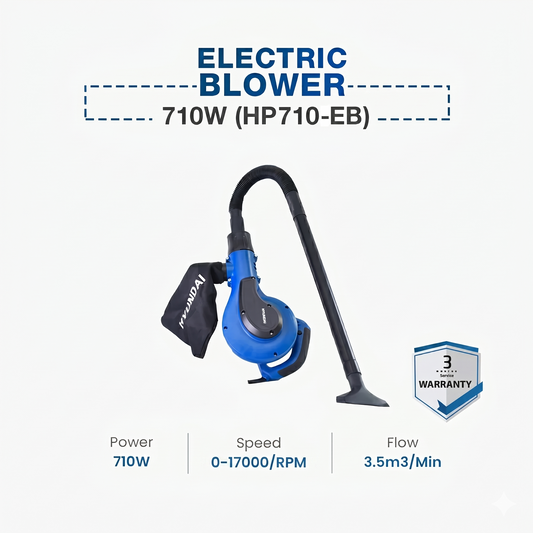
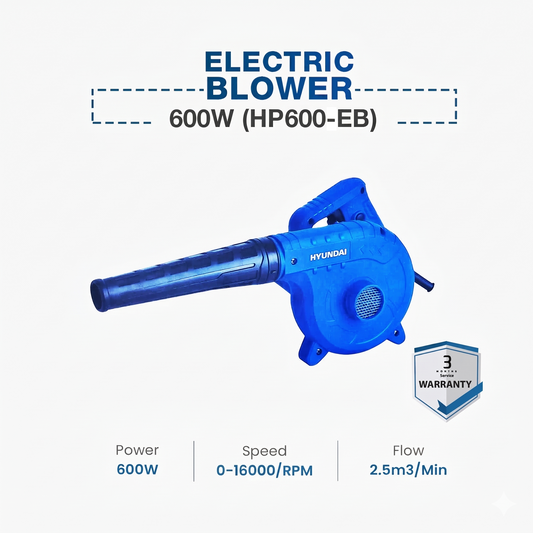
Hyundai's range runs from the HP450-EB at 450 W to the HP710-EB at 710 W. The guide to choosing the right blower wattage explains which end of that range suits car work.
Every electric blower in the line-up is listed in the Hyundai blower collection.
Bring Back the Shine With a Polisher
Washing removes dirt; polishing removes damage. Faded, swirled or lightly scratched clear coat can often be revived with a machine and the right pad, the work detailers call paint correction.
The Hyundai HP1300EP is a 1,300 W buffer with variable speed from 600 to 3,300 rpm, a 180 mm disc on an M14 spindle, and a weight of 3.68 kg. That makes it a rotary-type machine: fast and strong, but it rewards a careful hand.
- Start on a test panel. Try the pad and compound on a small, low-visibility area and check the finish in daylight.
- Keep the speed low. Begin near the bottom of the dial and raise it only once the polish is spread.
- Keep it moving. Use slow, overlapping passes and never park the pad in one spot, so heat cannot build and burn through.
- Stay off edges. Panel edges, body lines and plastic trim carry the thinnest paint — mask them with tape or finish them by hand.
- Work in small sections. Polish an area about half a bonnet in size, wipe off the residue, then move on.
Heat is the local catch. A panel that has stood in summer sun is too hot to polish, because the product dries before it can work. Polish in shade, early in the morning, on panels that feel cool to the touch.
Pro tip: clean the pad every panel or two. A pad clogged with spent polish cuts unevenly and runs hotter than it should.
The HP1300EP is listed in the Hyundai buffer collection.
Finish Tyres and Gaps With an Air Compressor
A small compressor closes the session. Its first job is tyre inflation, and the right figure is not the one moulded on the tyre.
The correct pressure is printed on the placard inside the driver's door jamb, or in the owner's manual, and it differs by car and by load. The sidewall number is the tyre's maximum, not a target. Check in the morning, before the car has been driven.
| Model | Tank | Motor | Airflow | Max pressure |
|---|---|---|---|---|
| HC3H24 | 24 L | 750 W | 140 L/min | 800 kPa |
| HCOF24 (oil-free) | 24 L | 1.5 HP | 130 L/min | 800 kPa |
Its second job is clearing dust from air vents, seat rails and door seals, at low pressure and held well back from the trim. Why cleaning calls for a gentler limit, and when a blower does the job better, is covered in the blower and compressor comparison for home cleaning.
Tank size and airflow decide how long a unit runs between refills; the guide to choosing tank size, power and airflow walks through the numbers.
Both 24-litre models sit in the Hyundai air compressor collection.
| Step | Why it matters |
|---|---|
| Rinse before any contact | Dry dust is grit that scratches the clear coat |
| Dry with air, then pat | Prevents hard-water spots and towel swirls |
| Test panel, low speed | A rotary-type buffer builds heat fast |
| Polish cool, shaded panels | Hot paint dries the product before it works |
| Tyres to the door-jamb figure | The sidewall number is a maximum, not a target |
Frequently Asked Questions
How often should car detailing at home be done?
Every three to four months suits most cars in Pakistan, with a quick rinse and blow-dry every week or two in between. Cars parked outdoors in strong sun usually need the polishing step more often.
Can a buffer damage car paint?
Yes, if it runs too fast, stays in one spot or touches panel edges. Low speed, constant movement and a test panel keep the risk small, and deep scratches are best left to a professional.
Is it safe to dry a car with a blower?
Yes. It is one of the safest methods because nothing touches the paint. Keep the nozzle a short distance from the surface and avoid blowing across dusty ground, which can throw grit back onto the car.
Why do white spots appear after washing a car?
They are minerals left behind as hard water evaporates. Drying quickly in shade prevents most of them; spots left to bake in the sun may need polishing out.
What tyre pressure should a car run?
The figure on the placard inside the driver's door jamb, or in the owner's manual. It varies by car and load, so check it cold in the morning rather than using one number for every car.
By the Hyundai Power team — home power, cooling & lighting specialists serving Pakistani households.