Electric Blower vs Air Compressor: Which Cleans Better?
Two Machines, Two Completely Different Jobs
Both machines move air, but they solve different problems. An electric blower is little more than a motor spinning a fan inside a moulded housing: it shifts a large volume of air at almost no pressure, which is what makes it right for sweeping loose dust off wide, open surfaces. An air compressor works the other way round, squeezing air into a steel tank — small home units usually top out around 8 bar, about 116 psi — and releasing it through a narrow nozzle in short, forceful bursts that dig packed grime out of tight gaps.
Hardware shops sell the first machine under half a dozen names: air blower, dust blower, leaf blower, garden blower. Same tool, different sticker.
Electric Blower vs Air Compressor: The Short Answer
The electric blower vs air compressor question comes down to volume against pressure. Volume clears wide, open surfaces quickly. Pressure digs packed grit out of narrow gaps.
Anyone shopping for a blower for cleaning a house, a shop floor or a car is almost always better served by the fan-driven machine. It is lighter, it needs no tank, and it is ready the second it is plugged in.
A compressor starts to make sense the moment air tools enter the picture — tyre inflation, spray guns, impact wrenches, nailers. Cleaning is a side benefit there, not the main event.
Side by Side on the Things That Matter
| Factor | Blower | Compressor |
|---|---|---|
| Air delivery | High volume, wide spread | Low volume, tight jet |
| Working pressure | Barely above room pressure | Up to roughly 8 bar (116 psi) |
| Ready to use | Instantly | After the tank fills |
| Typical power draw | 450W to 710W | Roughly 1.1 kW to 2.2 kW while loaded |
| Weight to carry | Hand-held, a few kilos | Tank-mounted, wheeled |
| Best cleaning use | Floors, fans, vents, upholstery | Caked grime in tight gaps |
| Second job | Drying wet surfaces | Running air tools |
One row settles most purchases: an air blower is ready the instant it is plugged in, while a compressor has to build tank pressure before the first useful blast. For a ten-minute clean-up, that wait matters more than the spec sheet suggests.
Where the Blower Wins Around the House
Homes here collect a fine, powdery dust that settles on everything within hours of a windy afternoon — ceiling fans, window grilles, sofa seams, the top of the almirah. Sweeping mostly moves it from one surface to another.
An electric blower clears the lot in a single pass, and it reaches what a cloth cannot: fan blades, curtain rods, the gap behind a fridge, the mesh on an outdoor AC unit.
For routine dust cleaning the lowest speed setting is usually plenty. Full throttle belongs in the garage, the stairwell and the roof.
Pro tip: open the windows before starting, work from the ceiling downwards, and finish with a damp mop so the dust leaves the room instead of resettling.
Where a Compressor Earns Its Keep
Some dirt refuses to blow away. Caked mud in an engine bay, sawdust jammed in a router collet, grit packed into chain links — that needs pressure, and an air compressor supplies it.
Most small air compressors sold for home use pair a 24 to 50 litre tank with a motor that scales with it — nearer 1.1 kW on a 24 litre unit, often 2 kW to 2.2 kW by the time the tank reaches 50 litres. The tank is the whole point: it stores energy so the nozzle can deliver a hard burst on demand.
The trade-off is bulk and waiting. A cold air compressor needs a minute or two to charge before the first proper blast, and the motor restarts with a loud thump every time tank pressure drops.
All of that capability is wasted on someone who simply wants a blower for cleaning. Buy the compressor for the tools; treat the cleaning as a bonus.
Workshops, Car Interiors and the 30 psi Rule
Workshop cleaning with compressed air carries one hard limit worth knowing: the US OSHA compressed-air standard, 29 CFR 1910.242(b), caps air used to clean surfaces at 30 psi at the nozzle, because anything harder can drive particles into skin and eyes. That is a US workplace rule rather than a Pakistani regulation, but it remains the clearest published benchmark, and hands in a Lahore workshop are no less exposed than hands anywhere else.
For end-of-day workshop cleaning, a fan-driven unit is faster than a broom and does not raise the same choking cloud that a high-pressure nozzle throws up at close range.
Car interior cleaning is where gentleness pays. A blower on its lowest setting lifts dust out of dashboard vents, seat rails and the gap beside the handbrake without firing grit into the trim.
On car interior cleaning jobs it helps to work outward — dashboard first, then seats, then floor mats — so nothing lands back on a panel that was already done.
That handles the inside. For caked mud and road film on the outside, a pressure washer is the tool that does it properly.
Running Costs, Voltage and Load-Shedding
Cost is where the electric blower vs air compressor comparison stops being close. A 700W unit run continuously at its full rated load for fifteen minutes uses about 0.18 units of electricity on that assumption — less than a pedestal fan burns over a long afternoon.
A 1.5 kW air compressor draws roughly twice that while its motor is loaded, and it keeps cycling on and off for as long as the tank is in use.
There is a local wrinkle too. On a 230V supply that sags around peak load-shedding hours, a compressor motor struggles hardest at start-up, when inrush current is highest. A simple fan motor copes with a soft supply far more comfortably.
Both machines are loud. Neither is a quiet-afternoon tool, so extended or repeated sessions are worth pairing with ear protection — and the dB rating printed on the datasheet is the number to check before buying.
Matching Electric Blower Wattage to the Job
Wattage is the shorthand for how much air a unit can shift. The Hyundai electric blower line runs from 450W up to 710W, which covers everything from a study desk to a service bay.
- HP450-EB (450W) — desks, electronics, shelves and light dust cleaning indoors.
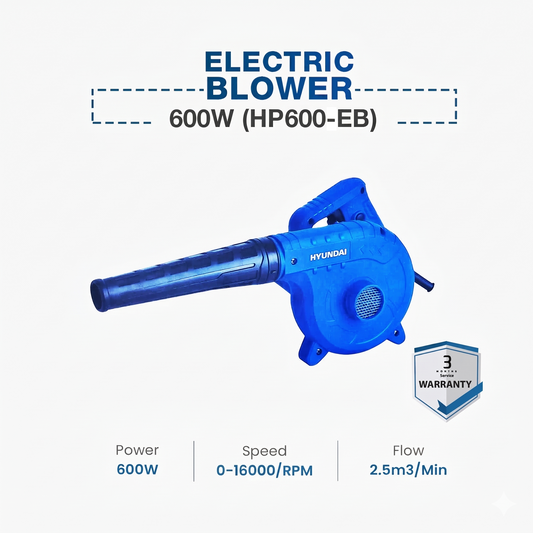
- HP600-EB (600W) — the household all-rounder: stairs, grilles, fans and car interiors.
- HP650-EB (650W) — garages, driveways and heavier dust cleaning after construction or renovation work.
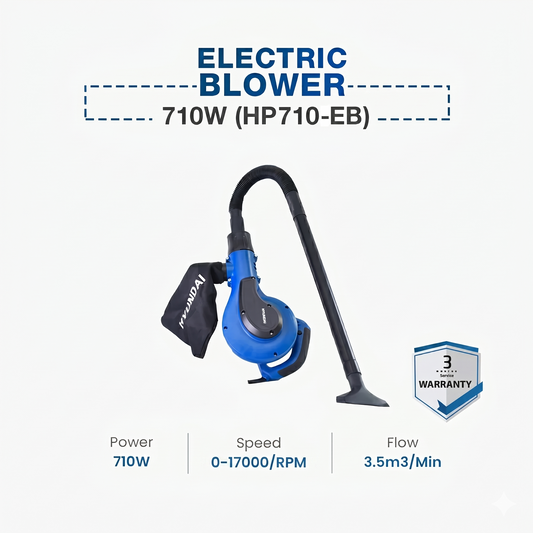
- HP700-EB and HP710-EB (700W / 710W) — workshops, rooftops and longer sessions where output matters more than weight.
Current specifications and availability for every model sit on the electric blower collection page, which is the easiest way to compare them side by side.
| Takeaway | Why it matters |
|---|---|
| Blower for loose dust | High air volume clears wide surfaces — floors, fans, vents, upholstery — in one pass. |
| Compressor for packed grime | A narrow high-pressure jet shifts what volume alone cannot reach or dislodge. |
| Buy on wattage, not badge | 450W suits indoor work; 650W and above suits garages, roofs and long sessions. |
| Respect the 30 psi cap | OSHA's 30 psi limit on compressed air used for cleaning is the benchmark for skin and eye safety. |
| Wear ear protection | Both machines run loud — check the datasheet dB rating and use plugs on long sessions. |
| Neither replaces a vacuum | Blown dust is relocated, not removed — pair it with a mop or vacuum indoors. |
Frequently Asked Questions
Which tool is better for everyday cleaning — a blower or a compressor?
For everyday cleaning at home, the blower wins the electric blower vs air compressor call because it clears wide surfaces fast, weighs little and needs no tank. A compressor is the better buy only when air tools are already part of the plan.
Can a blower replace a vacuum cleaner?
No. A blower relocates dust rather than collecting it, so it works best outdoors, in garages, on stairwells and in rooms that can be aired out afterwards. Indoors the two tools complement each other rather than compete.
How much electricity does a blower actually use?
A 700W unit uses roughly 0.18 units of electricity across fifteen minutes, assuming it runs continuously at its full rated load. Most household clean-ups are far shorter than that, so the running cost stays negligible even on a daily routine.
Is compressed air safe on a dashboard or a computer?
Only at low pressure. OSHA's 30 psi cap on compressed air used for cleaning is the benchmark to follow, and anything harder can force grit under trim panels or into electronics. A blower for cleaning delicate surfaces is the safer option.
What size air blower suits an average Pakistani home?
A 600W unit handles almost everything a household throws at it — ceiling fans, window grilles, stairs and car interiors. Anything above 650W is aimed at garages, workshops and long outdoor sessions.
By the Hyundai Power team — home power, cooling & lighting specialists serving Pakistani households.